Learn to facilitate movement experiences that go beyond dance & TAP INTO IT’s HEALING POWER.
A 5-week experiential facilitator training in the R.I.M (Rejoice In Motion) Integrated Dance Wellness™ Method combining specially designed movement sequences, embodied exploration, creative expression, nervous system regulation and reflective practice.
January 2027 | Online | 5 Weeks
[ APPLY FOR THE JANUARY 2027 COHORT ]
Limited places available.
APPLY HERE – https://forms.gle/1SeF769Ug5G8dMEA8
Are you looking to learn how to use Dance & movement to facilitate experiences for others?
What if you could facilitate movement that helps people connect with themselves? Perhaps you already work with people and have been wondering how to bring more movement into what you do.
Perhaps you’re a dancer or movement practitioner who wants to move beyond teaching choreography.
Perhaps you’re interested in becoming a dance wellness practitioner and want a structured way to learn how movement can be used to explore body awareness, expression, regulation and wellbeing.
Or perhaps you’ve experienced the impact of movement in your own life and want to understand how to facilitate it for someone else; responsibly, intentionally and with more than just a playlist and a few movement prompts.
This training is for that.
The R.I.M Integrated Dance Wellness™ Facilitator Training is a 5-week experiential training where you learn my approach to using dance and movement in wellbeing settings.
You won’t just be given a list of movements to teach.
You’ll learn the R.I.M Movement Sequences™ which are specially designed movement experiences developed as part of the R.I.M Method and understand the thinking, intention and principles behind them.
You’ll experience the sequences yourself first. You’ll explore what happens in your own body when you move.
You’ll learn how to observe movement without jumping to conclusions about what someone’s movement “means.”
You’ll explore how rhythm, breath, sensory awareness, movement quality, choice and pacing can be brought into a session.
And then you’ll start asking the questions when you’re the facilitator:
How do I introduce this movement?
What am I inviting the participant to explore?
How much structure is useful here?
Where do I give them choice?
What if someone doesn’t want to move in the way I’ve demonstrated?
How do I adapt this for different people and settings?
How do I know when to slow down, change direction or simply allow something to unfold?
That’s the difference between knowing a movement and knowing how to facilitate a movement experience.
What makes the R.I.M Method different?
The R.I.M Movement Sequences™
At the heart of the R.I.M Method is a collection of specially designed movement sequences created to translate the method’s principles into actual embodied experiences.
The R.I.M Integrated Dance Wellness™ Method grew from my own professional journey across physiotherapy, dance and Dance Movement Psychotherapy, and from years of developing and facilitating movement-based wellbeing experiences.
My physiotherapy background gave me a foundation in the physical body, movement and function.
My Dance Movement Psychotherapy training deepened my understanding of embodiment, movement as communication, observation, relational presence and reflective practice.
These sequences are not choreography to memorise for performance.
They are structured movement experiences with specific intentions; designed to explore different aspects of body awareness, grounding, regulation, expression, connection and integration.
During the training, you will learn to:
Experience the sequence → understand its intention → explore what it creates → learn how to facilitate it → adapt it thoughtfully.
Some of the core R.I.M Sequences include:
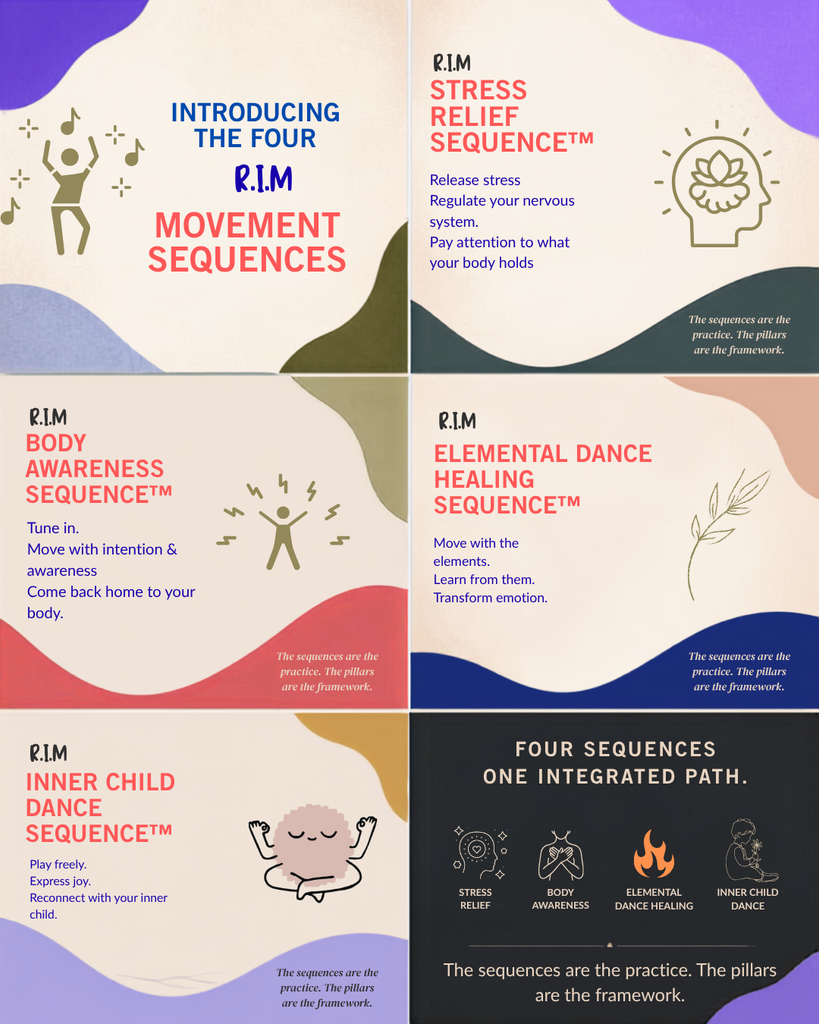
R.I.M Stress Relief Dance™
Moving through stress, tension and release
A specially designed multi-phase movement sequence exploring the relationship between stress, physical tension, movement, rhythm and release.
Rather than simply telling participants to “relax,” the sequence invites them to explore movement progressively; noticing the body, engaging with movement and gradually transitioning towards greater awareness and integration.
You will explore the sequence both as a participant and as a facilitator, learning about:
- Movement and physical tension
- Rhythm and repetition
- Changes in movement intensity
- Transitioning between activation and settling
- Choice and pacing
- Creating a contained movement experience
R.I.M Body Awareness Sequence™
From thinking about the body to experiencing it
A guided movement exploration designed to bring attention to the body through sensation, movement, breath, weight and awareness.
The intention is not to analyse the body.
It is to become curious about it.
Participants learn to notice sensations, movement qualities and areas of attention while developing greater awareness of their embodied experience.
You will explore how to facilitate body awareness without telling someone what they should be feeling.
R.I.M Elemental Dance™
Exploring movement through qualities and imagery
A visual movement sequence inspired by the qualities associated with the five elements: Earth, Water, Fire, Air and Space.
Drawing inspiration from ancestral wisdom, humanity’s longstanding relationship with nature and the elements, and our embodied connection with the natural world, this sequence invites participants to explore how elemental imagery can open up new possibilities for movement, expression and self-connection.
Earth. Water. Fire. Air. Space.
Each element offers a different lens through which to experience movement, sensation and the space around us. Rather than assigning fixed emotional meanings to each element, the sequence invites personal interpretation and exploration through changes in:
- Weight and grounding
- Flow and fluidity
- Speed and energy
- Shape and spatial awareness
- Rhythm and movement dynamics
The result is a creative, embodied exploration of movement beyond habitual patterns, drawing on the relationship between nature, imagination, bodily experience and personal meaning-making.
Within the R.I.M Integrated Dance Wellness™ Facilitator Training, participants will learn how to work with elemental imagery to guide movement exploration, adapt prompts and support participants in discovering their own interpretations and experiences. The focus is on translating the sequence into a facilitated movement experience that encourages body awareness, creative expression and self-connection.
R.I.M INNER CHILD DANCE SEQUENCE™
Exploring the parts of us that learned how to be in the world
The idea of the inner child refers to the younger parts of ourselves that carry experiences, emotions, needs, ways of relating and ways of responding that developed earlier in life.
These parts don’t simply disappear as we grow up.
Sometimes they show up in the way we seek approval, hold ourselves back, respond to mistakes, ask for help, take up space, play, connect with others — or struggle to give ourselves something we may once have needed from someone else.
Inner-child work can therefore be about more than remembering childhood.
It can be about noticing how earlier experiences may still live in the way we move, relate and respond in the present.
The R.I.M Inner Child Dance Sequence™ brings this exploration into the body.
Rather than asking participants to analyse their childhood or disclose personal experiences, the sequence uses movement as a way to explore qualities and experiences such as:
- play and spontaneity
- freedom and restriction
- being seen and hiding
- taking up space
- asking for what we need
- receiving care
- making choices
- trust and connection
- permission to be imperfect
- curiosity and imagination
A movement may become smaller when someone feels the need to stay unnoticed.
A gesture may repeatedly reach out and then withdraw.
Someone may discover that they find it easier to care for others than to receive care themselves.
Someone else may notice how unfamiliar it feels to move without trying to perform, please or “get it right.”
These observations are not interpreted as fixed psychological truths.
They become material for exploration.
The facilitator’s role is not to decide what a participant’s movement means or to tell them what happened to their “inner child.”
Instead, the facilitator creates the conditions for participants to notice, experiment, choose and make their own meaning.
The sequence can move between the younger self and the present self ; not to recreate childhood, but to explore questions such as:
What did I learn I was allowed to be?
What did I learn I wasn’t allowed to be?
Where do I still hold those rules in my body?
What becomes possible when I give myself a different choice now?
This is where movement becomes particularly valuable.
The exploration isn’t only something to think about.
It can be felt, tried, changed and experienced through the body.
And that makes the R.I.M Inner Child Dance Sequence™ not simply a dance about childhood, but a structured movement experience for exploring how our earlier ways of being may continue to influence the way we inhabit ourselves today.
The sequences are the practice.
The pillars are the framework.
The R.I.M Movement Sequences™ give you something concrete to experience, understand and facilitate.
The four R.I.M pillars give you the framework for understanding what sits underneath the experience – the intention, movement qualities, processes, choices and facilitation principles involved.
Together, they form the practical foundation of the R.I.M Integrated Dance Wellness™ Method.
The Four Pillars of R.I.M METHOD
01: Pulse & Presence™
Grounding • Regulation • Connection
Before we ask movement to express something, we can first create space to arrive.
Pulse & Presence™ explores movement through breath, rhythm, weight, support, sensation and awareness of the environment
This pillar is strongly informed by my physiotherapy background and my exploration of embodied awareness and nervous system regulation.
We will learn about body systems, dance & it’s connection with the body, fascia, muscles and much more.
We explore how movement can support people to notice their current state and discover possibilities for feeling more present, connected and resourced.
This may include:
- Grounding through weight and support
- Breath and rhythm
- Orienting to the environment
- Repetitive and rhythmic movement
- Sensory awareness
- Fascia of the body
- Muscles which hold the tension
- Noticing internal and external cues
Regulation is not about making everyone calm.
Different people respond differently to movement.
Something that feels settling to one person may feel activating to another.
So rather than prescribing a particular movement as “regulating,” R.I.M encourages facilitators to develop curiosity, choice and responsiveness.
The question becomes:
“What is happening for this person, and what movement possibilities might support them right now?”
APPLY HERE– https://forms.gle/1SeF769Ug5G8dMEA8
02: Expressive Dance Kinetics™
Expression • Creativity • Communication
Movement doesn’t always need to be translated into words. Many times, the body is your first responder.
Expressive Dance Kinetics™ explores movement as a form of creative expression and communication.
Kinesthesia, kinesthetic empathy & how the body moves.
Influenced by dance, creative movement and principles from Dance Movement Psychotherapy, this pillar invites exploration of movement qualities such as:
- Fast / slow
- Bound / free
- Strong / gentle
- Small / expansive
- Rhythmic / still
- Structured / improvised
The focus isn’t on producing beautiful movement.
It is on creating opportunities for people to explore what movement makes possible.
As facilitators, we learn not to impose meaning onto someone’s movement.
Instead of deciding what a movement “means,” we create space for the person to explore their own experience.
03: Embodied Dance Listening™
Awareness • Observation • Inner Connection
What happens when we listen to movement without immediately trying to interpret it?
Embodied Dance Listening™ develops the ability to notice movement with curiosity.
This pillar draws from embodiment, Laban-based movement observation and Dance Movement Psychotherapy principles.
Laban-based frameworks offer ways of observing movement through qualities such as:
Body • Space • Effort • Shape
Within R.I.M, these are used as lenses for observation rather than fixed psychological interpretations.
The facilitator learns to notice:
What is changing?
What qualities are emerging?
Where is there more or less movement?
What happens when rhythm changes?
How does the person relate to space?
And then, importantly:
Can we stay curious rather than immediately deciding what it means?
The participant remains the primary source of meaning.
04: Integrated Movement Flow™
Integration • Facilitation • Responsiveness
The pillars don’t exist in isolation.
Grounding can become expression.
Expression can create awareness.
Awareness can lead back towards grounding.
Integrated Movement Flow™ brings these elements together.
This is where you begin moving from participant to facilitator.
You will explore how to:
- Structure a movement experience
- Create an appropriate beginning and ending
- Build choice and agency
- Work with transitions
- Adjust movement intensity
- Respond to participants
- Create accessibility
- Hold boundaries
- Reflect on your facilitation
- Adapt rather than rigidly follow a script
The goal isn’t to produce facilitators who simply reproduce the R.I.M sequences.
It is to develop facilitators who understand the intention behind the movement and can respond to the people in front of them.
APPLY FOR THE TRAINING
Here- https://forms.gle/1SeF769Ug5G8dMEA8
Where does R.I.M METHOD come from?
The R.I.M Method has developed through the intersection of formal training, professional practice, personal exploration and lived experience. It brings together movement science, dance movement psychotherapy principles, embodied awareness and my own ongoing relationship with movement as a practice of self-connection.
Physiotherapy
My physiotherapy training provides a foundation in anatomy, movement, physical function, body awareness and the relationship between the physical and lived experience of the body.
It influences how I understand movement as something happening within a whole person rather than simply as an external shape or performance.
Laban-Based Movement Principles
Laban’s movement frameworks provide a language for observing and exploring movement qualities, dynamics, space and shape.
Within R.I.M, these principles support curiosity and observation rather than diagnostic interpretation.
Dance Movement Psychotherapy
My training in Dance Movement Psychotherapy has influenced my understanding of embodiment, movement as communication, relational presence, creativity, reflection and the importance of allowing meaning to emerge from the participant’s experience.
R.I.M is informed by these principles while remaining positioned as a dance and movement wellness methodology, not a psychotherapy modality.
Nervous System Regulation
My work also incorporates an understanding of the relationship between movement, sensory experience, rhythm, breath, attention, choice and nervous system states.
The training introduces participants to practical ways of thinking about regulation through movement. The emphasis is not on fixing or controlling the nervous system, but on developing greater awareness, choice and responsiveness.
Personal Practice, Meditation & Ancestral Wisdom
Alongside my formal training, R.I.M has been shaped by my own meditation practice, spiritual exploration and curiosity about ancestral relationships with movement, rhythm and the natural world.
These experiences have influenced how I approach movement as a space for listening, reflection and connection, extending beyond technique or physical expression alone. They inform the more intuitive and contemplative aspects of my work, while leaving room for each participant to discover their own relationship with movement and meaning.
R.I.M is an evolving methodology, shaped by the meeting of professional knowledge, embodied practice and personal inquiry.
From sequence to facilitation
One of the central things you’ll learn is that knowing a movement sequence is not the same as knowing how to facilitate it.
You will explore the difference between:
Leading movement
and
Creating an experience.
You’ll learn to consider:
- Who is in front of you?
- What might they need?
- What choices are available?
- How do you introduce the movement?
- How much structure is helpful?
- When do you invite exploration?
- When do you pause?
- How do you adapt?
- How do you close the experience?
- How do you invite reflection without imposing meaning?
This is where the R.I.M Method moves from a collection of sequences into a facilitation framework.
Your 5-Week R.I.M Journey
WEEK 1 — Foundations of R.I.M
Understand the philosophy, framework and foundations of the R.I.M Method.
Explore embodiment, dance therapy, and the facilitator’s role.
Learn → Experience → Reflect
WEEK 2 — Pulse & Presence™
Explore body awareness, grounding, rhythm, sensory awareness and more about the nervous system.
Learn and experience R.I.M movement sequences connected to grounding and body awareness.
Ground → Connect → Notice
WEEK 3 — Expressive Dance Kinetics™
Explore creativity, expression, movement qualities and movement as communication & information.
Learn how to facilitate expressive movement without turning it into performance.
Learn and experience R.I.M movement sequences connected to expression, stress-relief and creativity.
Explore → Express → Discover
WEEK 4 — Embodied Dance Listening™
Develop your movement observation and embodied listening skills. How do we learn to listen to our bodies and what they’re trying to convey to us?
Explore Laban-informed observation and the difference between observing and interpreting.
Listen → Observe → Reflect
WEEK 5 — Integrated Movement Flow™
Bring the pillars and sequences together.
Develop your own facilitation approach and complete your final practicum.
Integrate → Facilitate → Reflect
What is included?
5 weeks of online training
Structured learning delivered through Zoom (and other platforms as needed). Short videos will be shared as required.
Weekly live experiential sessions
90% of the training is via Live Zoom sessions combining teaching, movement exploration, discussion and facilitation practice.
R.I.M Movement Sequences™
Learn the specially designed R.I.M movement sequences and understand the intention and framework behind them.
Facilitator resources
Receive structured training materials, worksheets, reflection prompts and facilitation resources.
Practice & assignments
Apply the learning between sessions through personal exploration and facilitation practice.
Final practicum
Bring the learning together through a final facilitation experience.
Certificate of Completion
Receive a Certificate of Completion upon fulfilling the required components of the training.
Who is this training for?
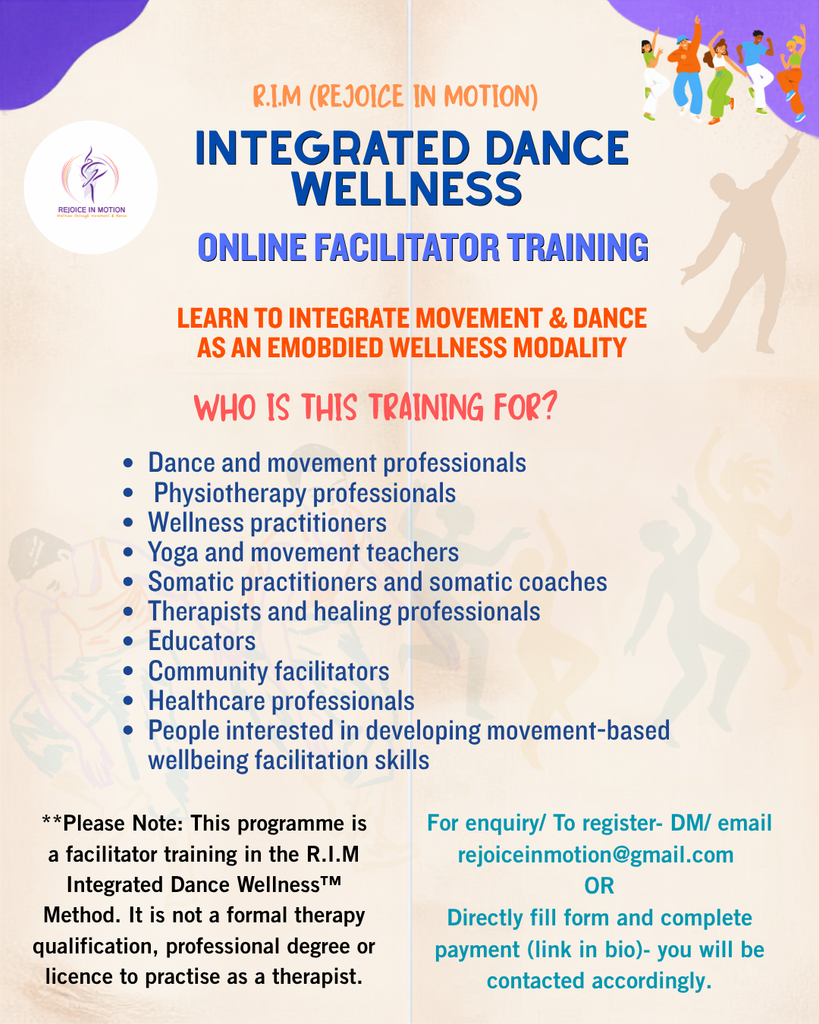
This training may be suitable for:
- Dance and movement professionals
- Wellness practitioners
- Yoga and movement teachers
- Somatic practitioners and somatic coaches
- Therapists and helping professionals
- Educators
- Community facilitators
- Healthcare professionals
- People interested in developing movement-based wellbeing facilitation skills
You do not need to be a professional dancer.
What you do need is curiosity about movement, willingness to explore your own embodied experience and a genuine interest in facilitating experiences for others.
This training is not about becoming a better dancer.
It’s about becoming a more attuned facilitator.
You don’t need perfect technique.
You don’t need to choreograph.
You don’t need to tell people what their movement means.
You need to learn how to notice, listen, offer, adapt and hold space.
About Manasi
Manasi JoSHI
Founder, Rejoice In Motion
Creator of the R.I.M Integrated Dance Wellness™ Method
Manasi is a Dance Movement Psychotherapy practitioner and movement-based wellness facilitator with a background in physiotherapy and orthopaedic manual therapy.
10+ years of experience in the field of healing and movement and more than 7 years of experience facilitating Dance Therapy & Integrated Dance Wellness Sessions for communities, individuals, organizations in Singapore & globally.
Her work sits at the intersection of movement, embodiment, expression and wellbeing.
Through Rejoice In Motion, she has facilitated movement experiences across healthcare, education, community, corporate and wellness settings.
Her approach has developed through her professional training as well as years of working with people through movement – continually exploring how dance can become more accessible, experiential and connected to everyday wellbeing.
She is the creator of the R.I.M Integrated Dance Wellness™ Method and its specially designed movement sequences.
What you will leave with
By the end of the five weeks, you will have:
A framework
for understanding the R.I.M Method.
Movement practices
that you have personally experienced.
R.I.M Movement Sequences™
that you have learned and explored as a participant & facilitator.
Facilitation skills
to begin creating and holding movement-based wellness experiences.
A deeper understanding of embodiment
and movement as a way of noticing and connecting.
A foundation for developing your own facilitation voice.
Certificate
Participants who successfully complete the required components will receive:
Certificate of Completion
R.I.M Integrated Dance Wellness™ Facilitator Training
Completion requirements include:
- Required live-session participation
- Completion of learning activities
- Practice and reflection assignments
- Final practicum
- Demonstration of understanding of the R.I.M Method and its facilitation principles
Important Scope & Boundaries
The R.I.M Integrated Dance Wellness™ Facilitator Training is a dance wellness facilitator training.
It is not a qualification in Dance Movement Psychotherapy, psychotherapy, counselling or clinical treatment.
Participants are expected to work within their existing professional training, competence and scope of practice.
The R.I.M Method does not teach facilitators to diagnose or interpret a person’s psychological state based solely on their movement.
Instead, the training emphasises curiosity, participant agency, embodied awareness, appropriate boundaries and reflective facilitation.
JANUARY 2027 Cohort
5-WEEK ONLINE TRAINING
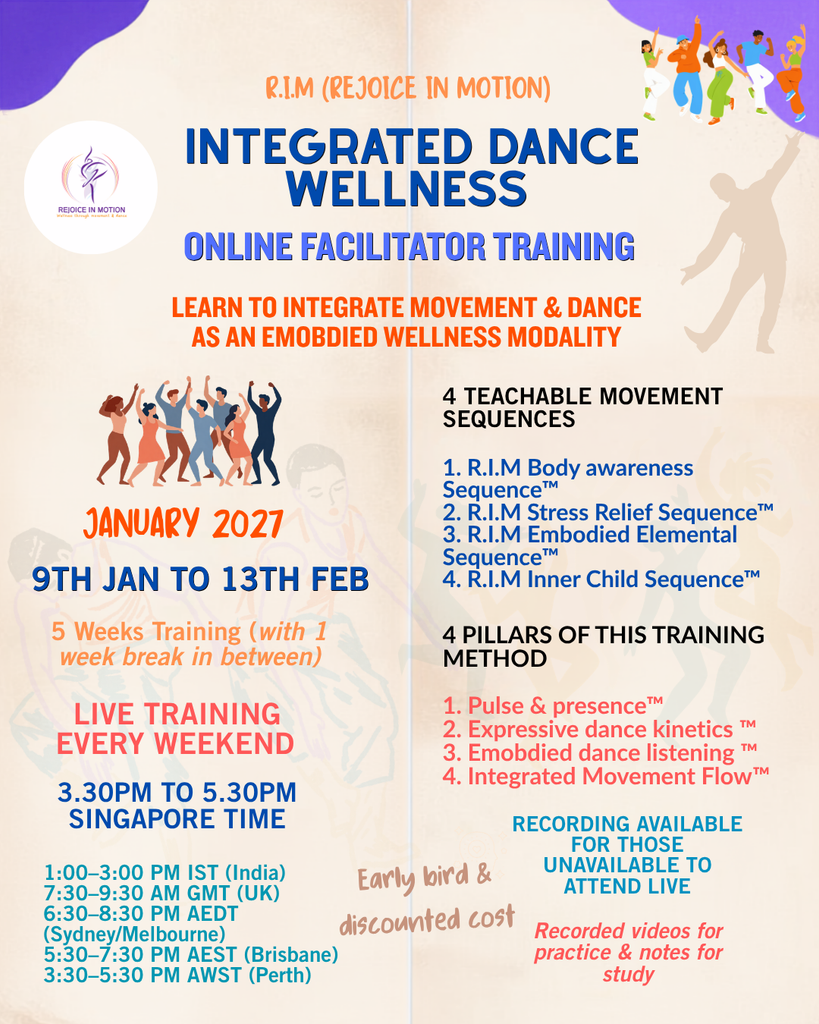
Dates: 9th Jan to 13th Feb 2027 (1 weekend break on 6th Feb )
Live sessions: 3.30pm to 5.30pm Saturdays
Session duration: 2 hours per week
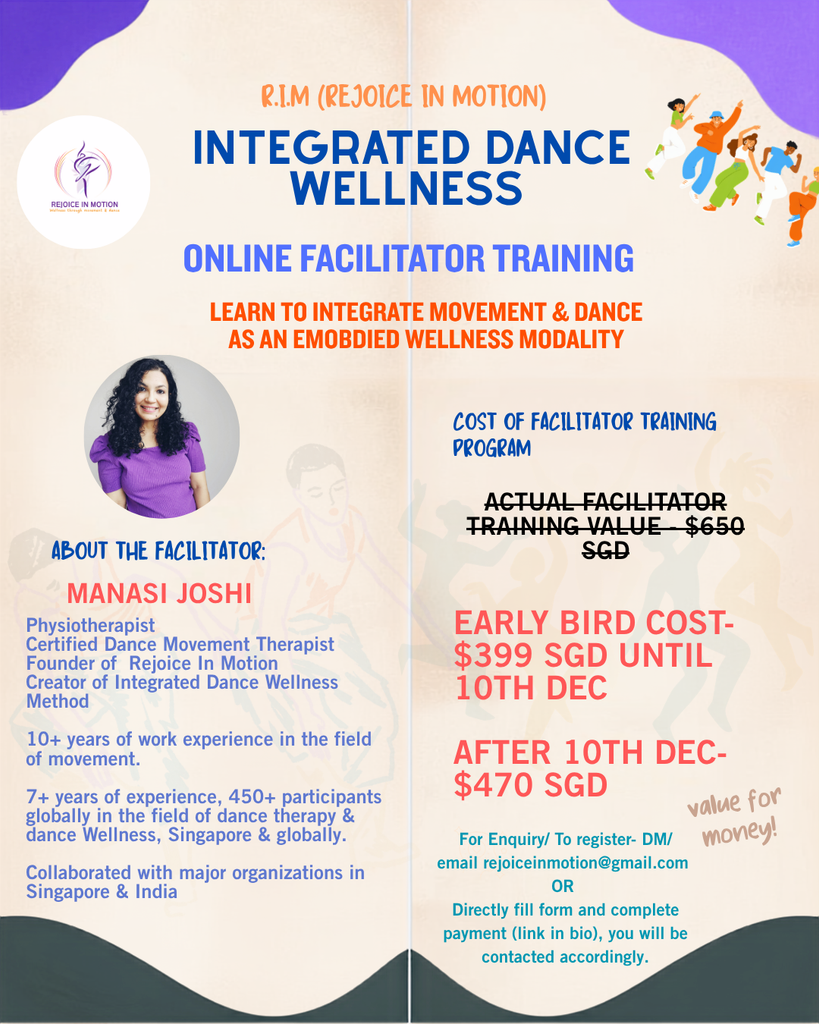
Actual Program Cost- $650 SGD
Early Bird- $399 SGD UNTIL 10th December
AFTER 10th DEC- $470 SGD (Discounted Price)
Those who previously submitted an Expression of Interest will receive the early-bird benefit.
APPLY / REGISTER NOW
Here- https://forms.gle/1SeF769Ug5G8dMEA8
Frequently Asked Questions
Do I need a dance background?
No. Professional dance training is not required.
Is this a Dance Movement Therapy qualification?
No. This is a facilitator training in the R.I.M Integrated Dance Wellness™ Method.
Will I learn actual movement sequences?
Yes. The R.I.M Movement Sequences™ are a central part of the training.
You will experience them, understand their intentions and explore how they can be facilitated and adapted.
Will I learn how to create my own movement sessions?
Yes. The training moves beyond learning sequences into understanding the principles behind them and developing your own facilitation skills.
Is the training completely online?
Yes. Self-paced learning will take place through Thinkific, alongside weekly live experiential sessions on Zoom.
How much time should I set aside each week?
2 Hours for the live training plus any assignments/videos practice during the week.
Will the live sessions be recorded?
Yes, for those who are unable to attend, recording wil be made available.
What happens after I apply?
You will complete the registration/application form. & payment. Your application will be reviewed and you will then receive confirmation.
Once your place is confirmed, you will receive access to the training platform and more information as the date approaches.
Ready to move differently?
You may come to this training because you love dance.
Or because you work with people.
Or because you’ve experienced what movement can make possible for yourself.
Whatever brings you here, the invitation is the same:
Move.
Notice.
Explore.
Facilitate.
Join the first R.I.M Integrated Dance Wellness™ Facilitator Training cohort.
January 2027 | 5 Weeks | Online
APPLY FOR THE TRAINING
Here- https://forms.gle/1SeF769Ug5G8dMEA8
Places are limited to keep the cohort experiential and supported.